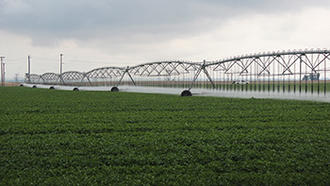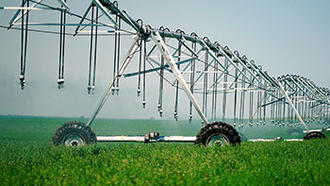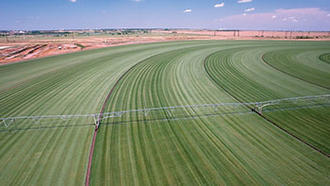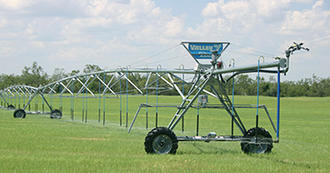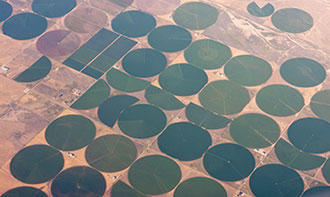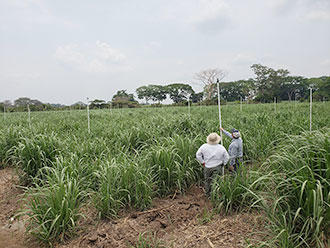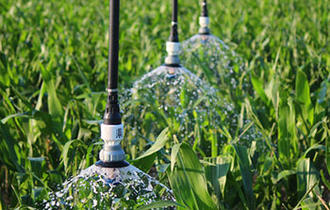
If your sprinklers, nozzles or pressure regulators are older, they may not be providing all that your crops need.
Save Energy & Money
If your sprinklers are older, it’s time to consider converting to a sprinkler package designed for low pressure. With rising energy costs, the savings of a low pressure pump can pay for that investment in a very short period of time. You may also be able to take advantage of cost sharing programs for your new low pressure system. Senninger Low Pressure-High Performance TM products are designed to operate at pressures as low as 10 psi where energy consumption is extremely low. Be sure to use pressure regulators to help maintain the designed flow for each applicator and help assure optimum performance and uniform distribution. Regulators are especially important if you have rolling terrain, if you use an end gun, or if your pump cycles on and off.
Save Water
A new sprinkler package can perform better than your older package simply based on the new technology available today. Many applicators provide better uniformity which allows you to do more with less. When you are looking at a new sprinkler package, be sure to adjust the flow to meet your soil and crop needs. Sprinklers with larger footprints allow the soil more time for soil to take in the water, preventing runoff. Utilizing goosenecks, booms and drops helps lower application intensity to preserve the integrity of your soil.
Improve Your Yield
Sprinklers that function improperly or nozzles that are worn distort the distribution pattern. This produces over- or under-watering. Over-watering can seal the soil surface causing run-off which carries away part of your soil. Over-watering that does penetrate the surface may leach nutrients below the root zone making them unavailable to your crop. Under-watering creates deficiencies and stress that reduce crop quality.
If pressure regulators are not functioning properly, they no longer provide consistent pressure. Your applicators are designed to operate at certain pressures for optimum performance and uniform distribution. Fluctuations in pressure impact flow, droplet size and distribution pattern. The system that was once designed to improve your yield is now causing crop damage.
With the new technology available, a new customized package provides greater benefits than ever before – benefits to your bottom line. Contact your local irrigation dealer. He can help you design a system that meets your specific crop and field needs.
Irrigation can be used in hot weather to cool crops and soil. This may lead to better yields.
Crops absorb water from the soil through their roots. The water is transported through the plant tissues and eventually released through the leaves to the atmosphere as vapor. This is known as transpiration. Evaporation is water that changes from a liquid to a vapor. These processes together are known as evapotranspiration. This water loss increases in hot, dry areas.
Small amounts of water applied throughout several short cycle irrigation events can lower crop temperature and raise the humidity of the air as the water evaporates. This reduces the water loss by transpiration. The water required for irrigation-cooling is less than the amount needed for soil irrigation. Irrigation-cooling does not replace an irrigation event. Adequate soil moisture must be maintained to achieve full benefits of cooling.
Irrigation-cooling is more effective if the application is uniform. Senninger Xcel-Wobblers and mini-Wobblers are ideal for this because they have up to 95% distribution uniformity.
Crop and climate conditions impact the need for crop cooling. The plant response to irrigation-cooling may vary at different stages of plant growth.
Soil salt is a major factor limiting crop growth. When salt concentrations in the soil are high, the movement of water from the soil to the root is slowed down. When the salt concentrations in the soil are higher than inside the root cells, the soil will draw water from the root, and the plant will wilt and die.
When the build-up of soluble salts in the soil becomes or is expected to become excessive, the salts can be minimized by applying more water than that needed by the crop during the growing season. This extra water moves most of the salts below the root zone by deep percolation (leaching). The rate at which leaching proceeds depends on the amount and quality of water added and soil characteristics. Saline soils cannot be reclaimed by chemical amendments, conditioners or fertilizers but can be reclaimed by leaching. The most effective and economical way for leaching is sprinkler irrigation.
Poor irrigation uniformity, however, can result in salt accumulation in parts of a field. High uniformity consistently move salts beneath the root zone. Xcel-Wobblers and mini-Wobblers are ideal applicators for leaching salts. Their unique off-center rotary action deflector gently delivers an instantaneous uniform pattern.
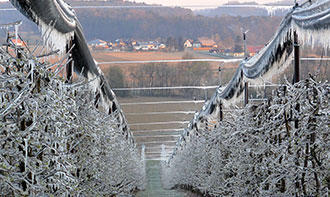
Many growers use sprinkler irrigation on berries and other crops for frost/freeze protection to temperatures as low as 22-degrees Fahrenheit. As the temperature drops below freezing, the water sprayed on the plants starts to freeze. Heat is released as the applied water changes to ice (80 calories of heat energy are released as 1 gram of water freezes). The heat absorbed by the plant can be enough to keep the plant above the freezing point if air temperatures don’t drop too low.
Blueberries in Florida
The application rate must be adequate to provide enough heat to protect the crop. Irrigation should continue until the ice is melting and loose. This usually occurs soon after the morning sun hits the crops.
Xcel-Wobblers
Irrigation for frost protection is usually done with sprinklers mounted above the crop canopy. The Senninger Xcel-Wobbler is ideal for frost protection because it:
has only one moving part for durability
constant rotary action helps prevent ice build-up
delivers a uniform pattern of consistent-sized droplet over a large area instantaneously
operates at very low pressure so that large zones can be protected at one time
Sprinkler irrigation is just one means of frost protection. However, success of any frost protection method depends on many factors including temperature, duration of low temperatures, humidity, and wind.
“Frost Protection with Sprinkler Irrigation” by Arthur W. Selders, State Extension Specialist Agricultural Engineering, Cooperative Extension Service, West Virginia.
“Frost/Freeze Protection for Horticultural Crop” by Katharine B. Perry, Ph.D., Extension Agricultural Meteorologist, Dept of Horticultural Science, College of Agriculture & Life Sciences, North Carolina State University
A flow control nozzle uses a flexible disk with a hole in the middle which allows maximum flow at the lowest pressures. As upstream pressure increases, the disk begins to flex forward, thus reducing the orifice diameter and restricting the flow. The thickness, durometer, and downstream support of the flexible disk all contribute to the amount of flow allowed to pass through the nozzle.
A flow control nozzle is simple and inexpensive, but much less accurate than a pressure regulator.
A high quality pressure regulator, when matched to the application, delivers a constant outlet pressure. This allows for optimum sprinkler spacing, uniform water application and a savings of both water and energy.
For additional reading: “Flow Control Devices for Center Pivot Irrigation Systems” by William L. Kranz, Suat Irmak, Derrel L. Martin, C. Dean Yonts. 1988; Revised February 2007. Neb-Guide published by the University of Nebraska–Lincoln Extension, Institute of Agriculture and Natural Resources. http://www.ianrpubs.unl.edu/epublic/live/g888/build/g888.pdf
If you take the same flow and spread it over a larger area, you can minimize the impact of the sprinkler pattern on the soil surface, reducing surface sealing and runoff. This larger distribution area also reduces the rate at which the soil is required to take in water. Increasing soak time can help reduce compaction and even wheel rutting.
Senninger designed a unique 125-degree double gooseneck (versus 180-degree conventional goosenecks) to divide the flow from one outlet along the center pivot to two applicators. The applicators, attached to drop hoses, are then positioned on opposite sides of the mainline. The hoses are secured to the truss rods to keep them in a fixed
Wider distribution using 125-degree goosenecks and boom systems (top) compared to the distribution of applicators with conventional 180-degree goosenecks (bottom).
position. Now the flow from one outlet is delivered to two distinct areas on opposite sides of the pivot.
Specially designed 125-degree single goosenecks can also be installed into the mainline to face alternate sides of the machine. This places applicators and their entire flow on opposite sides of the machine. This spread-out distribution and alternating areas from either of these installations helps minimize the impact on the soil.
At the towers, where the truss rods come close together, and on the overhangs at the end of the machine, boom systems can be used to move the applicators farther apart to achieve this same wide distribution of water flow.
Drip certainly has its place in irrigation but there are benefits to Wobblers for certain field installations.
In some soils, water does not disburse horizontally. Roots may not be close enough to drip outlets to receive adequate water. For this reason, additional irrigation is sometimes needed at certain stages of plant development.
Wobblers can be used during these stages because they can utilize the same low pressure and flow as drip. Wobblers deliver a gentle rain-like distribution over a large area. This uniform application improves germination and helps promote growth of mature plants encouraging roots to expand throughout moistened soil absorbing nutrients from a broader area. They also help cool the plants and the soil which can help increase plant growth.
There are some distinct advantages to Wobblers including:
Filtration is critical with drip systems to prevent clogging of the small orifice of the emitter. The larger nozzle orifice of Wobblers does not require the same filtration as drip systems.
Drip systems can cost more with components and installation. Maintenance and frequent replacement can add even more to that cost.
Wobblers last longer than drip systems.
Wobblers can also be used for fertigation.
Senninger introduced Wobbler technology in 1980. There are several models to choose from: mini-Wobblers, Wobblers, Xcel-Wobblers. For more information about Wobblers visit www.senninger.com
Every irrigation system experiences pressure variations which affect overall performance. Poor uniformity caused by pressure fluctuations can alter flow and sprinkler uniformity, affecting crop quality and yield. Fluctuations can be caused by changes in field elevation, zones cycling on and off, and activation of pivot end guns. The use of preset pressure regulators overcomes these variations.
If you have a low pressure irrigation system, pressure variations are an even greater concern. In a 20 psi (1.4 bars) system, a 4 psi (0.28 bars) variation means a 10% flow variation. That makes a big difference to sprinkler performance and directly impacts your overall system uniformity. The use of pressure regulators in your irrigation design is like insurance to keep your sprinklers and system performing at peak distribution uniformity.
A sprinkler won’t work well when made to operate outside of its recommended pressure range. High pressure causes overwatering near the sprinkler head and produces small droplets susceptible to wind drift and evaporation. High pressures can also damage sprinklers. Low pressure affects the sprinkler rotational speed. This creates dry spots near the head and overwaters in a donut shaped pattern. Too high or too low and you get bad coverage. The use of pressure regulators helps ensure that your sprinklers perform well.
Without pressure regulators, you will need to irrigate longer to water the drier areas, causing over-watering of the other areas. In addition to wasting water, this directly increases pumping costs, and energy consumption. Over-watered areas are at risk for disease, leaching, runoff, and soil damage. Leaching and runoff increases costs for fertilizers and can lead to pollution of ground water.
Pressure regulators may also be required if the pressure produced by your pump is too high / low due to irrigation zones that vary in size or zones with different elevations. When a system is retrofitted with low pressure sprinklers, the pump must be modified to match the pressure needs of the new components. Pressure regulators must be used in low volume systems to provide the optimal pressure required for lateral lines and other low pressure system components. Pressure compensating emitters and mini sprinklers perform better and last longer when operating with a balanced system pressure.
Senninger introduced the first quality in-line pressure regulator to the irrigation industry in 1966. Our regulators are 100% water-tested for accuracy and have a two-year warranty on materials, workmanship, and performance.
For more information about pressure regulators, contact Senninger Irrigation at info@senninger.com or visit www.senninger.com
The next time you pick up a plastic sprinkler, you might consider the science and technology it represents. Years of research have changed the way we use plastics. Different resins and blends offer different characteristics — strength and durability; flexibility or hardness; dimensional stability; resistance against UV, chemicals, and friction. These characteristics determine a product’s performance. When it comes to components for irrigation, water quality and chemical content are also considerations.
Many plastic irrigation components are injection molded. Pellets (or granules of plastic resins) are heated to the appropriate temperature to create a molten-like substance that is injected into a split-cavity mold. After a specific amount of time, the plastic cools and solidifies into the desired shape. Once the plastic is solid again, the mold opens and ejects the finished part.
In addition to the material selection, there is a true science to the actual injection molding process. The overall design of the mold, surface inside the mold cavities, placement of gates, thickness of the areas to be filled, cycle time, and temperature are all factors in a successfully molded part.
Founded in 1963, when most sprinklers were made of brass, Senninger pioneered the use of engineering-grade thermoplastics in the manufacturing of sprinkler components to help improve key performance criteria. They soon began injection molding in-house to closely monitor each molded part. Over the years, they have become experts in plastic injection molding. They warrant their products for two years on materials, workmanship, and performance. They warrant their nozzles for five years on orifice wear.
Different soil types respond differently to water. When it comes to irrigation, application rate must match your soil’s ability to absorb water. High application rates can create surface sealing and runoff, carrying surface soil away. Applying the water at a rate that matches the soil’s needs allows the water to penetrate the soil slowly.
Application intensity (the kinetic energy of the instantaneous water application) is also a consideration. High application intensity can damage your soil surface and alter the soil structure. This can damage its ability to absorb water for future irrigation applications. Lower application intensity is gentler. Applying the flow over a larger area reduces the application intensity.
Matching droplet size to the soil is yet another consideration. Don’t assume that smaller droplets are better. They are more prone to wind drift, lower uniformity, and higher evaporative loss. The optimum droplet size is the largest one possible that does not have adverse effects on the soil or the crop.
Here is a cutaway view of soil
Within healthy soil, different-sized particles are arranged allowing good infiltration. High application intensity breaks down the soil structure and disrupts this delicate balance. As infiltration begins, particles become segregated by size. The smaller particles become suspended and the larger clods dissolve. The water flows quickly through the soil below, filling in the open areas causing compaction. The smaller particles that had been suspended now rest on top of the soil, creating a sealing effect. This newly arranged soil structure prohibits future water applications from penetrating properly. The result is surface water buildup and runoff.
For more information about applicators designed for lowering application intensity, contact Senninger Irrigation at info@senninger.com or visit www.senninger.com